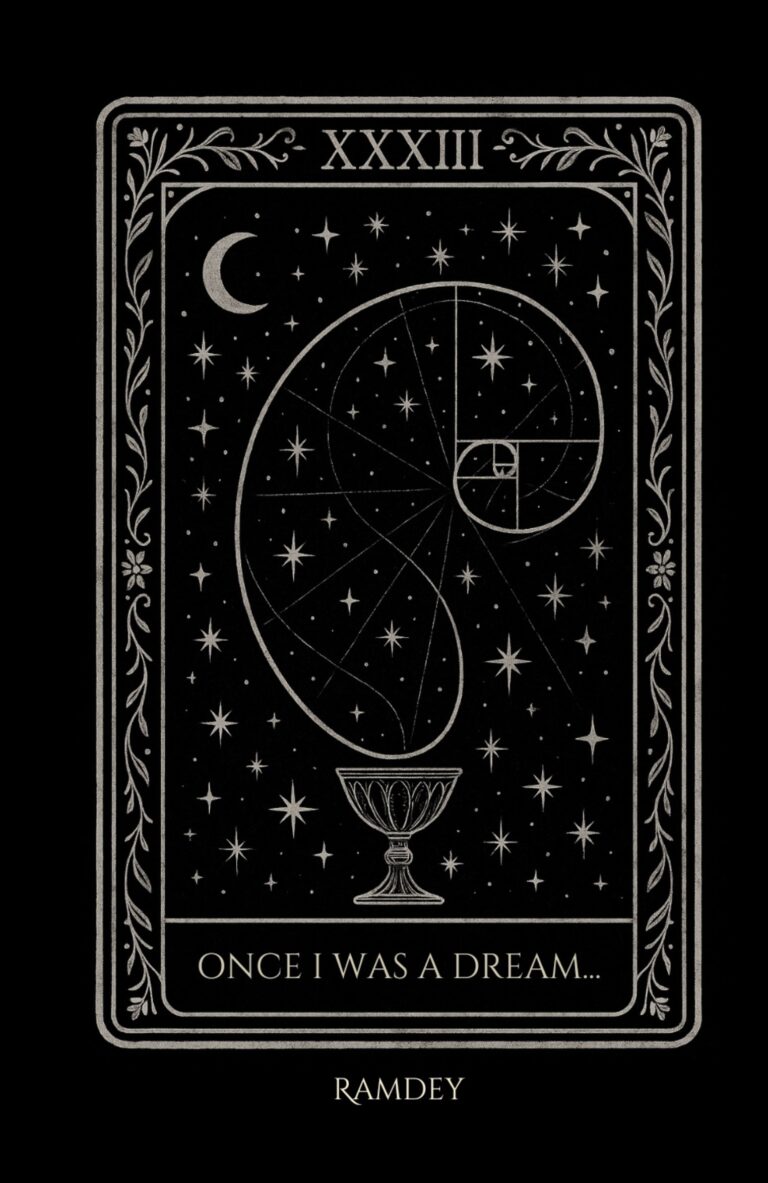
Once I Was a Dream is structured as a series of short dream-narratives called Dream Tapes—conversations between Nani (grandmother) and Munni (granddaughter) that unfold according to the logic of the subconscious rather than linear time.
These exchanges move through archetypal configurations—the Dreamer, the Mirror, the Chalice, and more—not as symbols to be decoded, but as perceptual states through which the mind models itself.
The book is grounded in the understanding that the subconscious mind is not random, but patterned. In cognitive science, non-conscious processes are responsible for memory consolidation, emotional integration, and predictive modeling. Dreams arise where these processes surface—where experience is reorganized, tested, and restructured outside deliberate control. In this sense, dreaming functions less as fantasy and more as simulation.
Alongside each Dream Tape are Astral Notes—philosophical reflections written at the transition between dreaming and waking, when non-linear associations begin to stabilize into thought. Where the Dream Tape preserves experience in its imaginal state, the Astral Note performs the work of cognitive translation: intuition becomes articulation, pattern becomes language, insight acquires structure without being reduced to explanation.
Each chapter concludes with Reflective Exercises that engage the reader’s own cognitive processes. These are not instructions, but inquiries—designed to activate attention, memory, and self-observation. Rather than delivering meaning, the book creates conditions in which meaning can emerge through participation.
Once I Was a Dream approaches the subconscious as an active intelligence—one that operates continuously beneath awareness, shaping perception, emotion, and identity. By treating dreams as data, dialogue as method, and reflection as experiment, the book invites the reader into a disciplined encounter with their own inner processes.